

KEY POINTS
- Nigeria plans a $2 billion climate fund.
- Green bonds show strong investor demand.
- The UAE deal targets clean energy investment.
Nigeria is turning to green finance to drive its energy transition, with President Bola Tinubu unveiling plans for a $2 billion climate fund.
The government aims to channel growing investor appetite into projects that reduce emissions while strengthening resilience across critical sectors.
Green finance gains traction
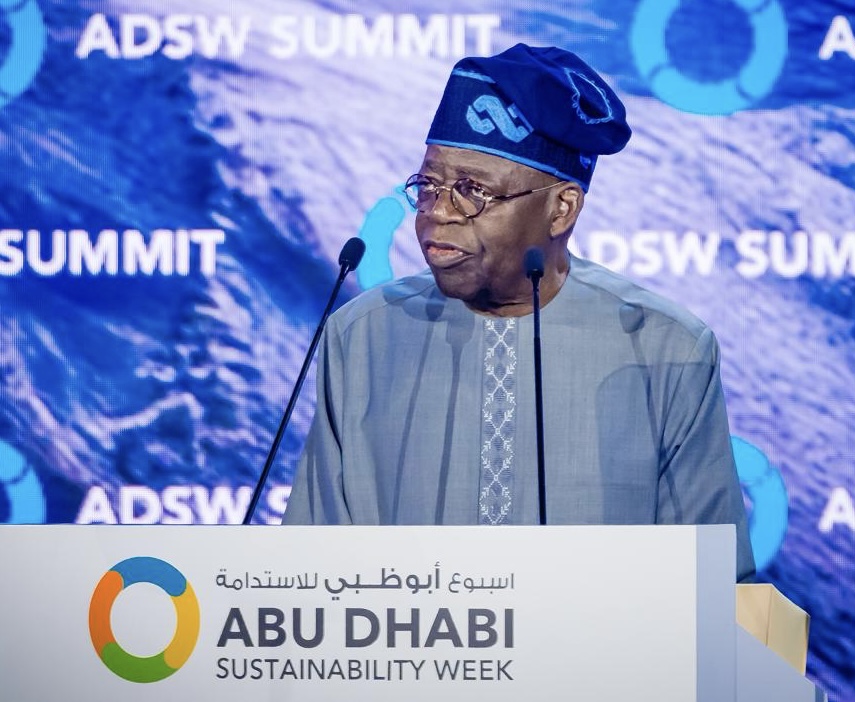
Speaking at the Abu Dhabi Sustainability Week summit on Tuesday, Tinubu outlined the strategy. He said Nigeria’s Climate Investment Platform will mobilise $500 million for climate-resilient infrastructure. The platform targets projects that can withstand climate shocks and reduce long-term risks.
Alongside it, the National Climate Change Fund is seeking a $2 billion capital base. The fund will support projects that lower emissions and improve climate resilience nationwide.
Tinubu said demand for Nigeria’s green bonds shows sustained investor interest.
He noted that investors remain willing to back climate-linked assets in Africa’s most populous nation. A 50 billion naira sovereign green bond issued in 2025 attracted subscriptions of 91 billion naira. Lagos State’s green bond was oversubscribed by nearly 98 percent, according to Tinubu. The strong take-up has been cited by the government as evidence that global capital is available for well-structured climate projects.
Deals and funding ambitions grow
Tinubu also announced that Nigeria and the United Arab Emirates have signed a Comprehensive Economic Partnership Agreement. The deal is intended to expand trade and investment across sectors that include renewable energy, aviation, logistics, agriculture, digital trade and climate-smart infrastructure. Officials see the agreement as a way to deepen capital flows at a time when Nigeria is seeking to broaden its economic base.
Nigeria faces deep environmental and policy challenges as it works toward its Energy Transition Plan. The strategy targets net-zero emissions by 2060 while aiming to deliver universal access to energy. Key hurdles include cutting gas flaring and methane emissions in a country that remains heavily dependent on fossil fuels for revenue and power generation.
Tinubu said the government aims to unlock $25 billion to $30 billion annually in climate finance to achieve transition goals.
A new Climate and Green Industrialisation Investment Playbook will guide private investors and stakeholders through manufacturing policy and regulatory compliance. The initiative builds on earlier programs, including the Nigeria Sovereign Investment Authority’s five-hundred-million-dollar Distributed Renewable Energy Fund, launched in March 2025, according to Reuters.
The fund is designed to stimulate local financing and encourage private sector participation in renewable energy and climate-focused infrastructure projects.
“These reforms show Nigeria is ready for business,” Tinubu said. He added that non-oil exports have grown by 21 percent and that investment commitments now exceed $50 billion across key sectors. Nigeria is also prioritising technology partnerships to modernise its electricity grid, deploy artificial intelligence to improve efficiency, and advance pilot projects in electric mobility and green industrialisation.
The president urged a shift toward blended finance structures that combine public, philanthropic and private capital. Such models, he said, can absorb early losses and reduce reliance on sovereign guarantees, which he argued place an unfair burden on emerging economies.