KEY POINTS
- Atiku Abubakar says NNPCL’s admission that reopening Port Harcourt Refinery is wasteful confirms his call for privatisation.
- He criticised political motives behind refinery revival efforts and warned against new foreign partnership deals.
- Structural weaknesses and decades of ineffective public spending make privatisation the most viable solution for Nigeria’s refineries.
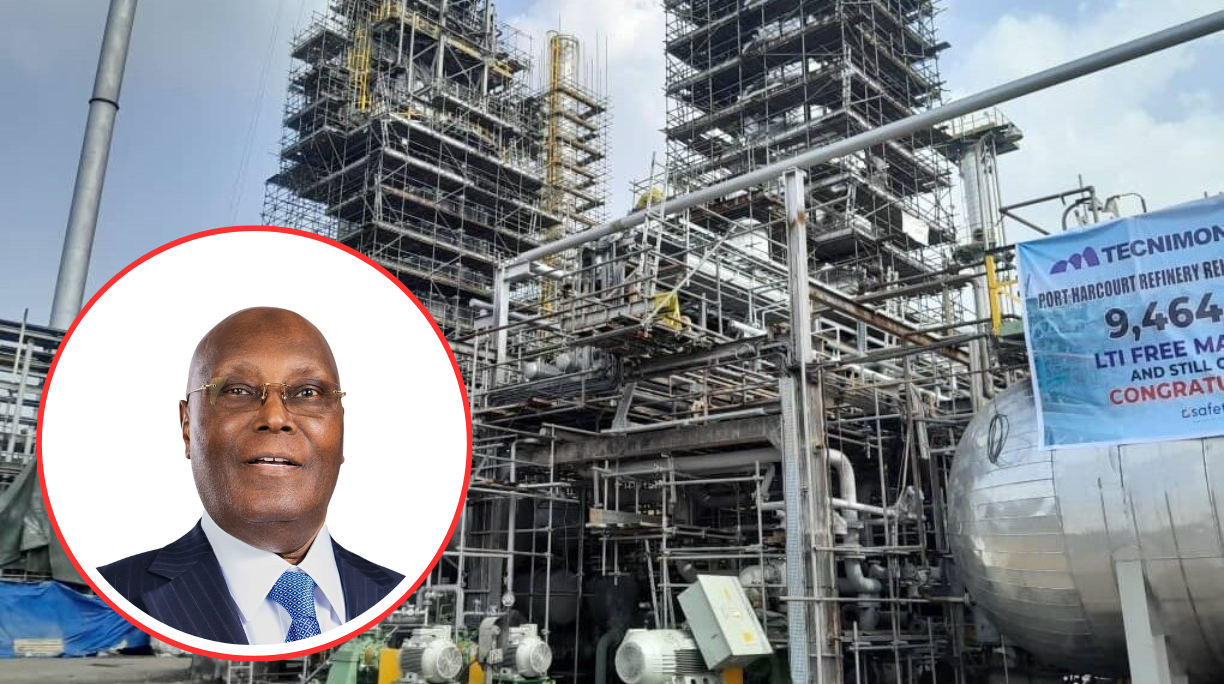
Former Vice President Atiku Abubakar has argued that the Nigerian National Petroleum Company Limited’s (NNPCL) admission that reopening the Port Harcourt Refinery is a waste of resources validates his long-standing call for privatisation.
Atiku made the statement on his Facebook page on Sunday, responding to reports that the refinery had consumed about $1.5 billion without producing petrol.
He described the continued funding of non-performing refineries as economically indefensible, pointing out that billions of naira have been spent on salaries and maintenance with little or no output.
Political Motives Over Economic Sense
Atiku recalled that he had repeatedly advocated privatisation but faced criticism, accused of attempting to sell public assets to cronies. He said the recent push to revive the refineries was politically motivated rather than guided by economic reasoning.
“The latest efforts to revive these refineries were driven by political pressure, not sound economic policy,” he said. He also warned against new agreements with foreign partners, noting that such arrangements could replicate past failures.
The former vice president highlighted deep structural issues in Nigeria’s refining sector, including gaps in technical capacity, weak financial discipline, and poor management. He argued that selling the refineries before rehabilitation would have avoided rising debt and depreciation of state assets.
Atiku concluded that decisive privatisation remains the most viable path to end decades of inefficiency and waste in the country’s refining industry.