

KEY POINTS
- Ramaphosa confirmed South Africa will still create an independent electricity transmission company despite reports of a revised Eskom breakup plan.
- A proposed restructuring model keeping Eskom divisions under one holding company sparked concern among analysts and investors.
- A new government task team will resolve outstanding issues and set timelines for implementing the power sector reforms.
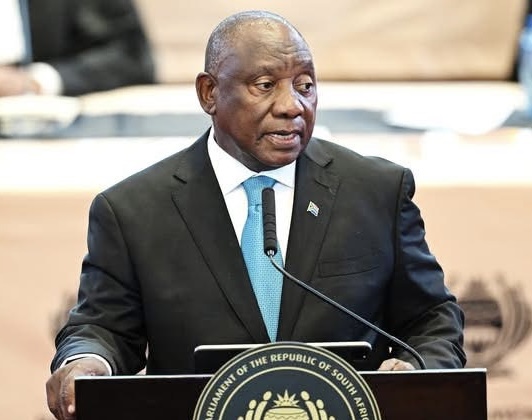
South African President Cyril Ramaphosa has reaffirmed that the government remains committed to creating an independent electricity transmission company, pushing back against claims that authorities intend to dilute or reverse plans to restructure the state power utility Eskom.
Speaking before lawmakers during his state-of-the-nation address in Cape Town, the president said the new entity will own and control transmission assets and operate the national electricity market once established.
The clarification follows a December statement indicating that Electricity Minister Kgosientsho Ramokgopa had approved a revised unbundling strategy. That proposal suggested Eskom would still be divided into generation, distribution, renewable energy, and transmission divisions but kept under a single holding company structure.
Under that revised plan, ownership of the national grid would remain with Eskom instead of being transferred to an independent system operator, contradicting earlier reform proposals.
Original reform plan aimed at deeper separation
In 2019, Ramaphosa proposed splitting Eskom into three fully independent entities to encourage competition, improve financial management, and make it easier to address the utility’s debt challenges. Analysts viewed that earlier plan as a major structural reform designed to modernise the country’s electricity market.
Experts warned that scaling back those reforms could undermine investor confidence and delay progress in stabilising South Africa’s power sector.
Energy analysts have expressed concern that weakening the original unbundling strategy could threaten the multi-billion-dollar Just Energy Transition Partnership, an international financing initiative supported by European nations to help South Africa shift away from coal-fired power generation.
Investors and policy observers argue that clear institutional independence for the transmission system is critical for attracting private investment into renewable energy and grid infrastructure.
Ramaphosa disclosed that a dedicated task team has been set up under the national energy-crisis committee to address outstanding restructuring questions. The group will focus on implementation timelines, structural design, and operational clarity to ensure the reform process proceeds efficiently.
Government officials say the committee’s work is intended to remove uncertainty and align stakeholders on a single roadmap for Eskom’s future.