KEY POINTS
- ExxonMobil says further gas investment in Guyana depends on faster approvals, transparent regulation, and coordinated infrastructure readiness.
- The Hammerhead project could become a flagship development linking offshore production directly to domestic energy supply.
- Guyana credits decades of reforms and oil revenues for rapid economic growth, infrastructure expansion, and plans to slash electricity costs.
A senior executive of ExxonMobil says the pace of future investment in Guyana’s natural gas sector will depend largely on how efficiently government bureaucracy functions and whether a predictable, rules-based system is maintained.
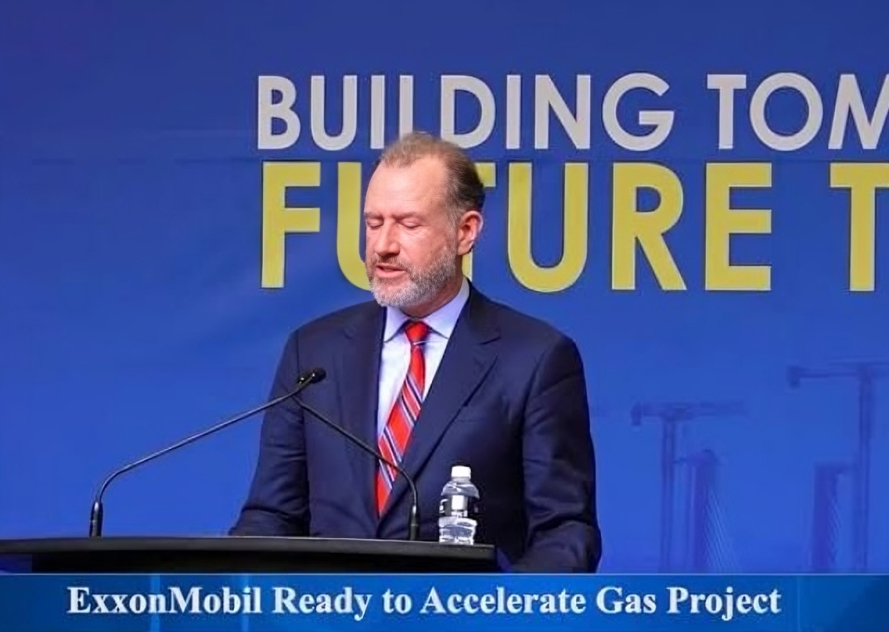
Speaking at a major regional energy gathering, Dan Ammann, president of ExxonMobil’s upstream division, stressed that the same factors that enabled Guyana’s rapid oil success, clear institutional roles, transparency, shared standards, and disciplined execution will be even more critical for gas development.
He explained that natural gas projects are more complex than oil, requiring infrastructure such as processing facilities, compression pipelines, and power generation systems.
According to him, success depends on coordinated progress across the entire value chain upstream extraction, midstream transport, and downstream utilisation.
Ammann added that ExxonMobil will move in “lockstep” with regulators, utilities, financiers, and industrial users, noting that the speed of development is determined not by a single company but by the readiness of the whole system, including environmental approvals, land and marine permits, and market demand.
Hammerhead Project Positioned as Strategic Launchpad
Ammann highlighted the proposed Hammerhead development, valued at about GY$6.8 billion, which could produce up to 95 billion cubic feet of gas daily. The project is expected to become the company’s first offshore development designed from the outset to pipe gas to shore.
Part of the gas would power the floating production vessel, while the rest could support Guyana’s gas-to-energy programme, future industries, or be reinjected to improve oil recovery. He said such flexibility ensures maximum value from combined oil-and-gas operations.
He also pointed to promising reserves in the southeast section of the Stabroek Block, describing the opportunity as highly compelling.