KEY POINTS
- Dangote’s Lagos refinery gains global importance as closures in Europe and the U.S. tighten Atlantic Basin fuel supply.
- Operational setbacks have limited output, but corrective measures could increase gasoline, gasoil, and jet fuel production significantly.
- Expansion plans aim to reach 1.4 million barrels per day, making it the world’s largest single-train refinery and a stabilizing force for global fuel markets.
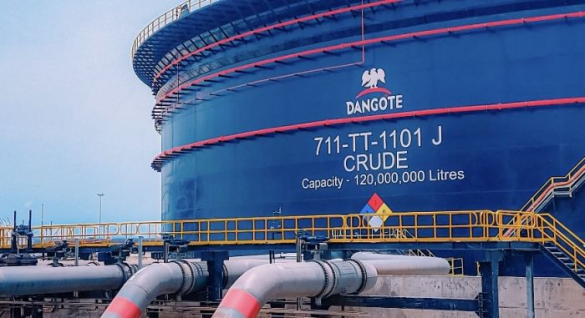
Aliko Dangote, Africa’s richest man, is seeing his huge refinery in Lagos become more important around the world as refineries close in Europe and North America.
According to the energy intelligence company Kpler, almost 900,000 barrels per day of refining capacity in the West of Suez have been permanently taken away. This has changed the way fuel is supplied around the world.
These shutdowns are having a big effect on the Atlantic Basin, which is relying more on late-cycle mega-refineries like Dangote’s 650,000-barrel-per-day facility and Mexico’s Dos Bocas refinery. Kpler says that these plants are now very important for keeping fuel flows stable in the area.
Even though it is big, Dangote’s refinery has had problems with its operations. Due to mechanical problems in its core conversion unit (RFCC), output has been limited to 60–65 percent. A corrective shutdown in December that lasts 50 to 60 days is seen as a key step toward reaching full production.
Kpler said that once the refinery’s operational problems are fixed, it could produce about 300,000 barrels per day (bpd) of gasoline, 150,000 bpd of gasoil, and 140,000 bpd of jet fuel. This would help ease supply problems caused by the Western shutdowns.
Rapid expansion and global relevance
The refinery started up in 2024 with a capacity of 350,000 barrels per day. It now processes about 650,000 barrels per day, and production is expected to reach 700,000 barrels per day soon. The Dangote Group wants to increase capacity to 1.4 million barrels per day. This would make it the largest single-train refinery in the world.
Engineers India Limited is in charge of the $350 million expansion project. They are both the Project Management Consultant and the EPCM consultant. David Bird, the CEO, has said that the expansion could be done in three years. He is also getting the refinery ready for a possible public listing, which would make it Nigeria’s largest industrial asset.
As Europe’s refining footprint gets smaller, the Dangote refinery is becoming a stabilizing force for the Atlantic Basin, helping to make up for the effects of closures around the world. Not only does its larger capacity make Nigeria’s industrial sector stronger, but it also makes Africa a bigger player in the global energy market.
With a net worth of $30.4 billion, Aliko Dangote continues to use his businesses to help both the economy at home and on the continent grow.