KEY POINTS
- The Iran-Israel conflict has forced Europe to aggressively court Africa as a replacement energy supplier.
- EU foreign policy chief Kaja Kallas visited Nigeria and Ghana in March, signing a defense pact and a 288 million euro support package.
- With China closing in as Africa’s top trade partner, Europe is racing to lock in energy supply agreements across the continent.
Something has shifted in the way Europe talks about Africa. It is not subtle anymore.
Years of aid, governance funding and attached conditions have defined Europe’s approach to the continent. That model, according to a new report by the African Political Outlook, is over. What is replacing it looks more honest: a relationship built on what each side actually needs.
And what Europe needs, badly, is energy.
A crisis that changed the calculus
The Iran-Israel conflict has throttled the Strait of Hormuz and disrupted roughly 20 percent of global oil and liquefied natural gas shipments. Combined with the supply shock from Russia’s 2022 invasion of Ukraine, European governments are hunting hard for stable alternatives. Africa keeps coming up as the answer.
Italy moved first this week. Prime Minister Giorgia Meloni announced closer energy cooperation with Algeria, targeting additional gas volumes as Rome weathers the Middle Eastern fallout. Algeria, Nigeria and Mozambique have rapidly become the names European energy officials reach for when the conversation turns to alternatives. These are not diplomatic courtesies. They are supply-chain decisions.
Brussels shifts tone, and direction
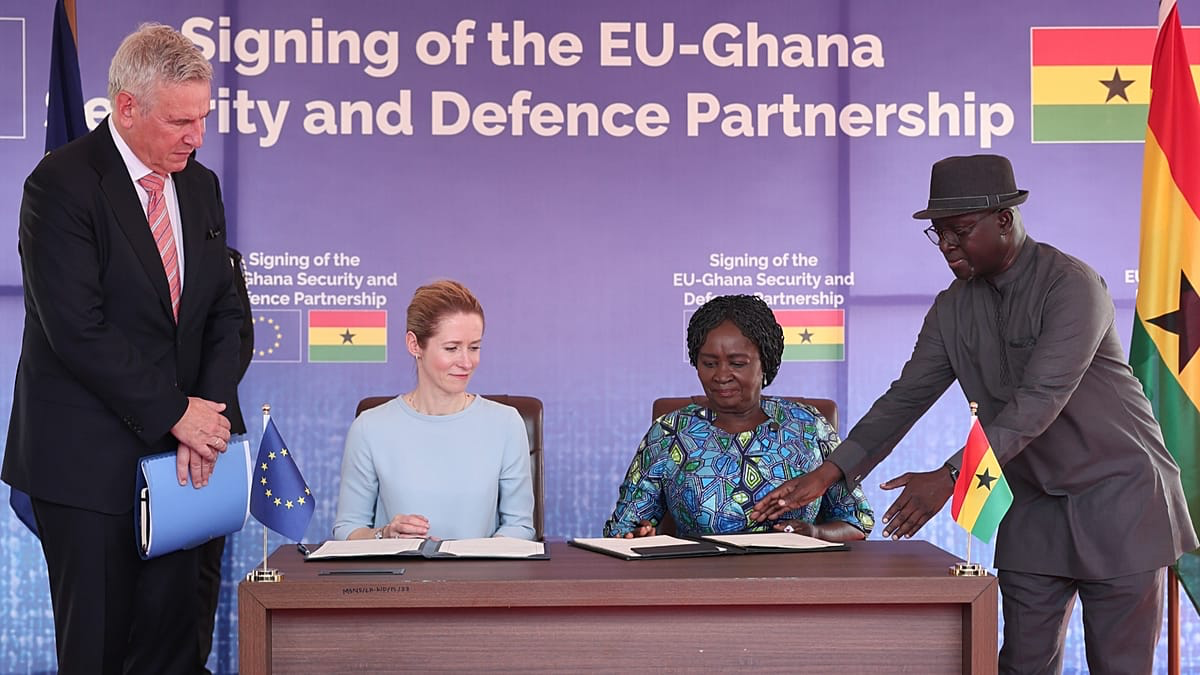
EU foreign policy chief Kaja Kallas traveled to Nigeria and Ghana in March, signing a 288 million euro support package in Abuja and, in Accra, the first-ever EU-Ghana Security and Defence Partnership on counter-terrorism and maritime security.
“This partnership allows us to work more closely in areas that matter for the security of our citizens, both in Europe and Ghana,” Kallas said.
Mouctar Bah, president of the Brussels-Africa Hub, said Europe has been slow to read the shift. “People are still living in the past,” he said. “They are not seeing the future.”
EU-Africa trade reached 355 billion euros in 2024, but China is closing in fast as Africa’s top trading partner. A string of coups between 2020 and early 2026 across Mali, Burkina Faso, Guinea, Gabon, Niger, Guinea-Bissau and Madagascar also dismantled France’s Sahel presence, weakening Europe’s collective leverage and pushing individual nations toward their own bilateral energy deals.
Africa’s strategic value has not changed. The Hormuz crisis has simply made it impossible to ignore.