

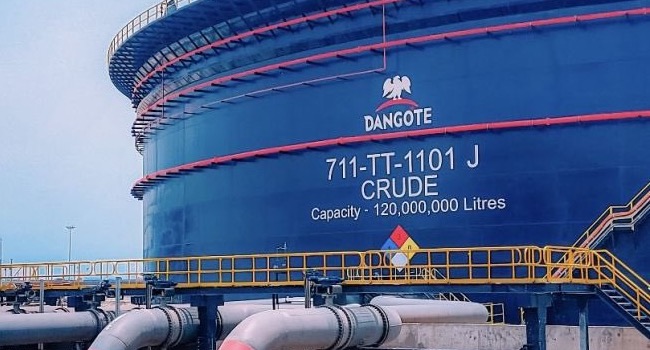
KEY POINTS
- Dangote Refinery has reached full production capacity of 650,000 barrels per day.
- Petrol output could rise to 75 million litres daily, reducing fuel imports and forex pressure.
- Analysts say the refinery’s impact could strengthen the naira and stabilise Nigeria’s energy supply.
The Dangote Petroleum Refinery has attained full operational capacity, with its Crude Distillation Unit and Motor Spirit production block now running at their designed limit of 650,000 barrels per day.
The milestone follows a successful maintenance and optimisation exercise, after which the plant completed a 72-hour performance test conducted with technology partner UOP to verify efficiency, safety, and equipment integrity.
Officials say the development places the facility among the most sophisticated single-train refineries in the world and confirms its readiness for sustained high-volume output.
Billionaire investor Femi Otedola described the refinery’s full-capacity operation as a historic turning point for Nigeria’s economy. He said increased domestic refining could significantly ease demand for foreign exchange used to import fuel, adding that the naira could appreciate to below N1,000 per dollar before the end of the year if the momentum continues.
Otedola also praised Aliko Dangote for delivering what he called a transformational project capable of reshaping Africa’s energy landscape.
Output surge expected to transform fuel supply
At peak capacity, the refinery can produce up to 75 million litres of petrol daily, alongside diesel and aviation fuel. This volume is projected to comfortably meet national demand and potentially guarantee export capacity. During the last festive season, the facility already supplied between 45 million and 50 million litres of petrol per day to the Nigerian market.
Chief Executive Officer David Bird said the seamless ramp-up demonstrates strong engineering precision and operational resilience, noting that additional processing units will begin their own performance tests in the next phase of commissioning.
The crude distillation unit, often regarded as the heart of the refinery, separates crude oil into components such as naphtha, kerosene, and diesel, while the motor spirit block upgrades gasoline streams to modern fuel standards. With both units fully stabilised, analysts say the refinery is positioned to reduce fuel imports, strengthen energy security, and support broader economic stability.