KEY POINTS
- Eskom signed a heads of agreement with ZET to anchor South Africa’s first LNG import terminal.
- The 3,000MW gas-to-power plant will be built in the Richards Bay Industrial Development Zone.
- ZET is a joint venture between Royal Vopak, Reatile Group and Transnet Pipelines at Richards Bay.
South Africa has been talking about gas-to-power for years. On Friday, it signed something.
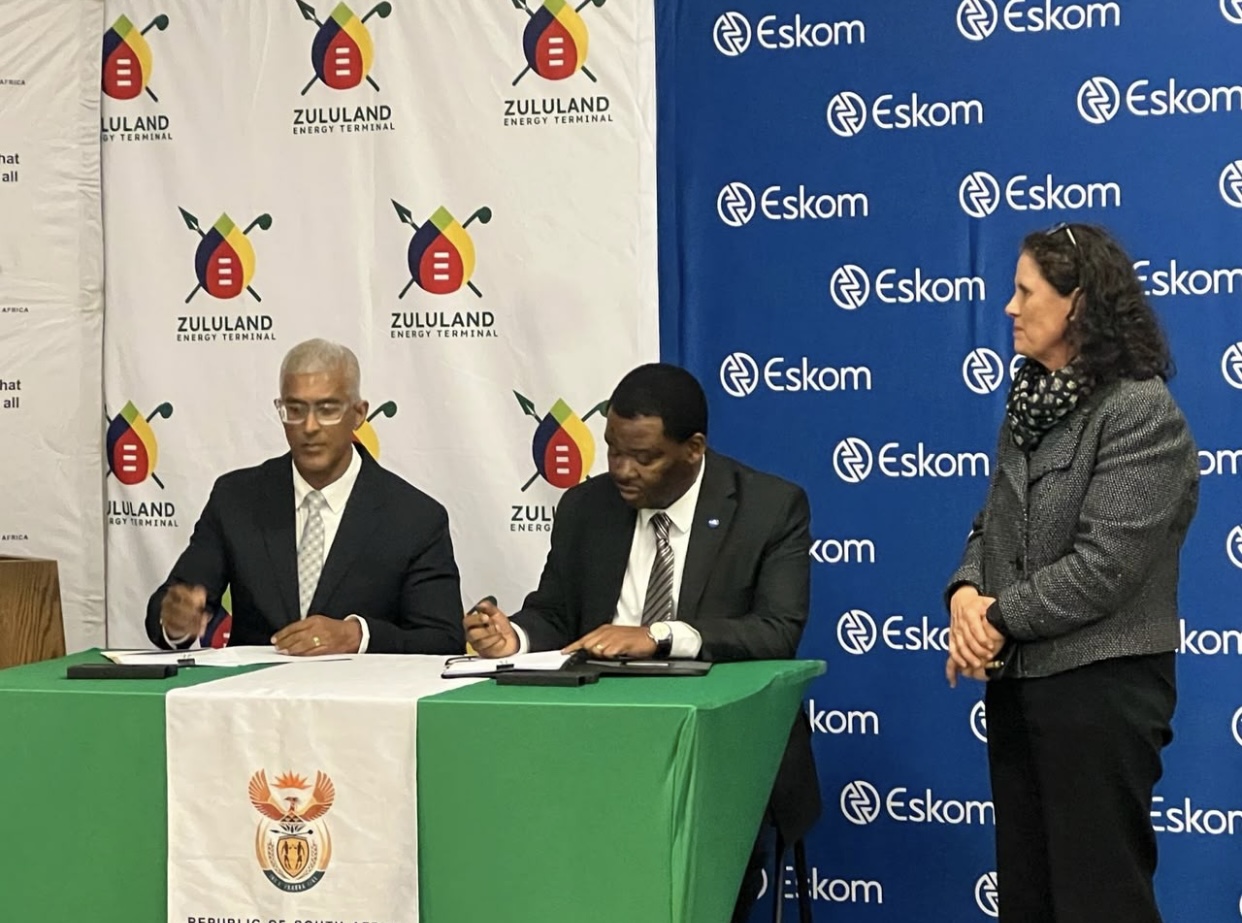
Eskom and Zululand Energy Terminal signed a Heads of Agreement in Pretoria, establishing the framework for a long-term strategic partnership that will underpin the state utility’s planned 3,000-megawatt gas-to-power programme. The signing took place in the presence of Electricity and Energy Minister Kgosientsho Ramokgopa, signaling government backing at the highest level.
Under the agreement, Eskom takes on the status of foundation customer at the proposed Zululand Energy Terminal, which will provide open access to liquefied natural gas import, storage and regasification infrastructure at Berth 207 in the South Dunes precinct of the Port of Richards Bay in KwaZulu-Natal.
Eskom Group Chief Executive Dan Marokane said the foundation customer status is a critical enabler. “The intention is a long-term contracting approach to minimize volatility and support system reliability while aligning with the IRP 2025 objectives,” he said.
A project years in the making
ZET is a joint venture between Vopak Terminal Durban, owned by Royal Vopak of the Netherlands, Reatile Group of South Africa and Transnet Pipelines. ZET was selected as the preferred bidder to develop, construct and operate the LNG terminal in 2024.
Transnet CEO Michelle Phillips described the signing as a strong commercial signal. “It demonstrates confidence in the project, strengthens its bankability and brings South Africa closer to establishing its first LNG import terminal,” she said.
The gas plant will use regasified LNG as its primary fuel and is designed for a 25-year life cycle, operating mainly as a mid-merit plant. It is classified as a Strategic Integrated Project under the Infrastructure Development Act and is incorporated in South Africa’s Integrated Resource Plan 2025. Development will follow a private sector participation model using project financing and long-term power offtake agreements.
What this means for South Africa’s energy future
Eskom framed the deal around three priorities. First, it strengthens energy security alongside growing renewable energy capacity. Second, it cuts diesel consumption by replacing open-cycle gas turbines with more efficient gas-fired generation. Third, it addresses what the utility calls the gas cliff, a looming shortfall in domestic gas supply as Mozambique’s Pande and Temane fields decline.
ZET Director Oliver Naidu said Eskom’s participation sends a clear message to the market. “As one of our anchor customers, Eskom’s participation demonstrates growing confidence in LNG as an enabler of energy security, grid stability and industrial growth,” he said.