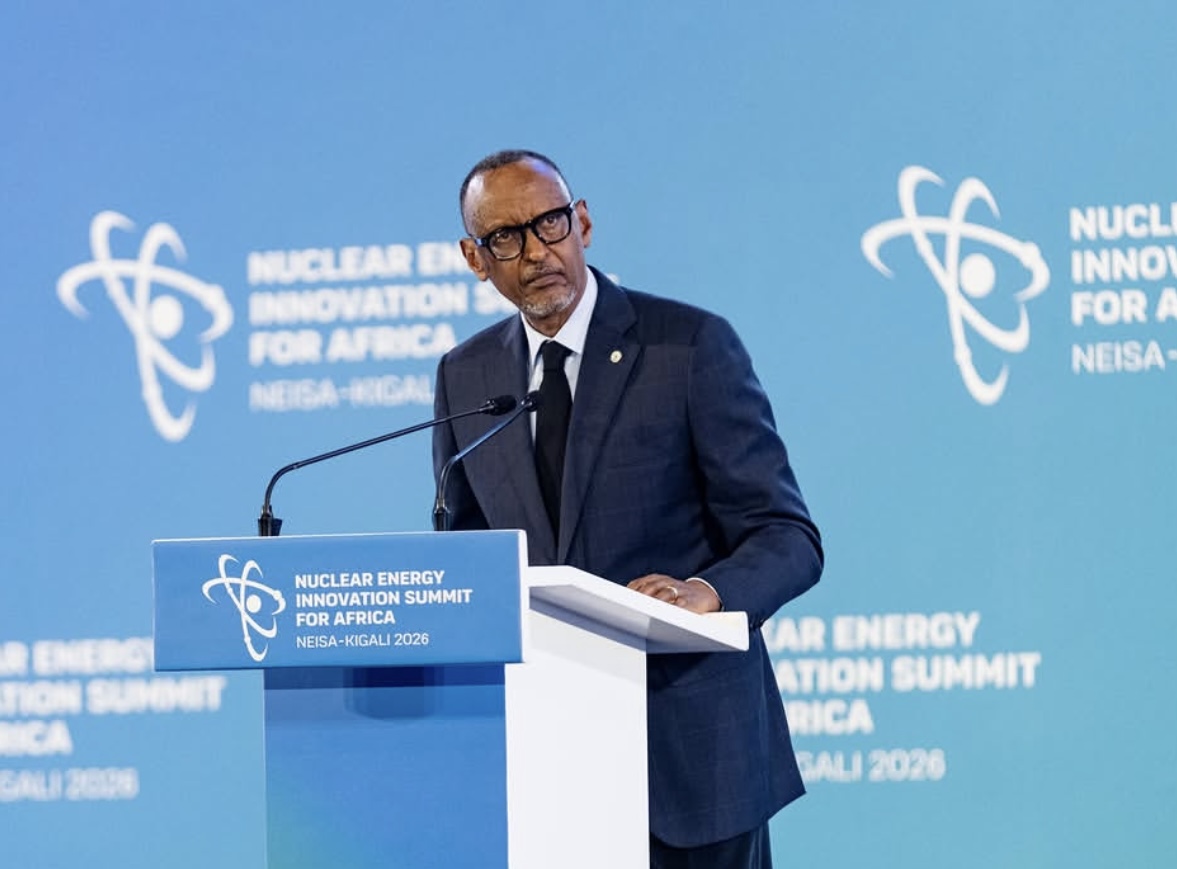
KEY POINTS
- Rwanda and Russia signed a nuclear cooperation roadmap at the Nuclear Energy Innovation Summit in Kigali.
- Rosatom will build a Nuclear Science and Technology Centre in Rwanda using a Russian-designed research reactor.
- President Kagame says Rwanda plans to have nuclear energy fully operational by the early 2030s.
Rwanda has made its nuclear ambitions official. On May 19, the country signed a cooperation roadmap with Russia’s state nuclear corporation Rosatom at the Nuclear Energy Innovation Summit in Kigali, setting in motion a plan that President Paul Kagame says will deliver operational nuclear power by the early 2030s.
The roadmap was signed by Rosatom’s deputy director-general, Nikolay Spasskiy, and Rwanda’s ambassador to Russia, Jeanne d’Arc Mujawamariya. It defines specific steps through the end of 2026, including the launch of a project to build a Nuclear Science and Technology Centre in Rwanda based on a Russian-designed research reactor. Training of Rwandan staff in Russia is a separate priority in the document.
The agreement builds on an inter-governmental deal signed in Moscow on December 5, 2018, covering the peaceful uses of nuclear energy between the two countries.
Why Rwanda is betting on nuclear power
Kagame did not soften the reasoning. Africa needs reliable power to compete, and renewable energy alone will not be enough. He made the case plainly at the summit.
“Modern manufacturing, mineral processing, digital infrastructure, and advanced healthcare all depend on reliable power,” he said. “The rapid expansion of artificial intelligence and data-driven industries will also significantly increase energy consumption. Countries that cannot meet this demand will struggle to compete.”
Rwanda also completed Phase 1 of the International Atomic Energy Agency’s Integrated Nuclear Infrastructure Review, confirming it is on track with its development timeline.
For Rwanda, small modular reactors are the preferred path. Kagame described them as better suited to African realities because they can be deployed gradually, integrated into smaller grids and financed at lower cost than traditional large-scale nuclear plants.
The broader MoU and what it covers
Alongside the Rosatom roadmap, a broader memorandum of understanding was also signed at the Kigali summit. That MoU extends the cooperation into nuclear medicine and healthcare, widening the scope beyond electricity generation into direct public health applications.
Kagame said the international financing environment is shifting in nuclear energy’s favor, with more institutions now recognizing it as part of the clean energy transition. He urged international review and regulatory processes to support African countries moving in this direction rather than slow them down.
Rwanda’s nuclear push is part of a wider continental trend. Several African governments are exploring small modular reactors as a practical solution to chronic power deficits, and Rwanda’s early institutional progress puts it among the more credible candidates on that list.