

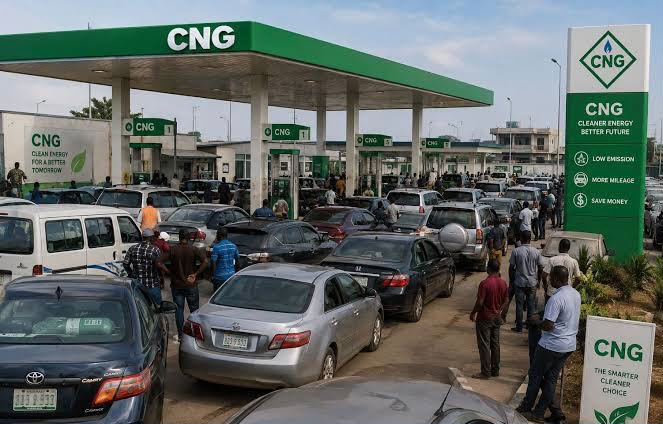
Long queues at compressed natural gas stations should ease by the end of the year as more refueling stations open, the Presidential Initiative on CNG and Electric Vehicles, known as Pi-CNG, says.
CNG queues have become a daily feature in Abuja, Lagos and Kano as more drivers convert their vehicles to cheaper gas, and the number of stations has not kept pace with the rush.
Why the CNG queues persist
In July, a commercial driver at the NASENI Portland Centre in Dei Dei, Abuja, said he joined the line around 4 a.m. and was not served until about noon. At a NIPCO station in Kubwa, the queue stretched about two kilometers, Leadership reported.
Pi-CNG said then that the queues reflect growing public confidence in CNG. A former national secretary of the Independent Petroleum Marketers Association of Nigeria, Mike Osatuyi, said they show a mismatch between the pace of infrastructure and the government’s ambitious adoption targets.
The FCT CNG Users’ Forum, which represents vehicle owners and transport operators, has also complained about shortages, poor station management, alleged extortion by some attendants and queue jumping.
How many stations are coming
In July, Coker of Pi-CNG said new stations were opening every one to two weeks, with at least 10 more due before the end of that month and close to 70 more before the end of the year.
Executive Chairman Ismaeel Ahmed has said the country went from fewer than 10 CNG stations before 2023 to about 90 when the initiative started, and that a first batch of 500 new stations has been ordered, with delivery expected by the end of October.
Delivery is not the same as operation. Ahmed has said stations cannot be switched on the day they arrive, because each needs construction, transport and connection to gas supply before it can sell fuel.
Progress is visible in places. Kano now has 12 CNG stations, up from virtually none a year ago, after two private facilities opened Sunday, Pi-CNG said, and four new stations eased queues in Abuja in January.
What drivers and marketers want
Osatuyi argued that letting conventional petrol stations add CNG dispensing would help ease congestion. Motorists have also called for longer opening hours at busy stations and for more outlets to open.
Pi-CNG says a CNG bus ride from Gwagwalada to Abuja costs at least 40% less, and the government wants one million CNG vehicles by the end of 2027, with about 120,000 converted so far.
Even 70 more stations by December would be a small addition against a target of one million vehicles. Each station can serve only as many cars as its compressors and gas supply allow.
Reports so far give no station by station schedule, so drivers have little way to check whether the year end promise is on track.
Queues signal that demand has arrived. Whether they ease by December will depend less on promises than on how many new stations open, and whether they get gas.